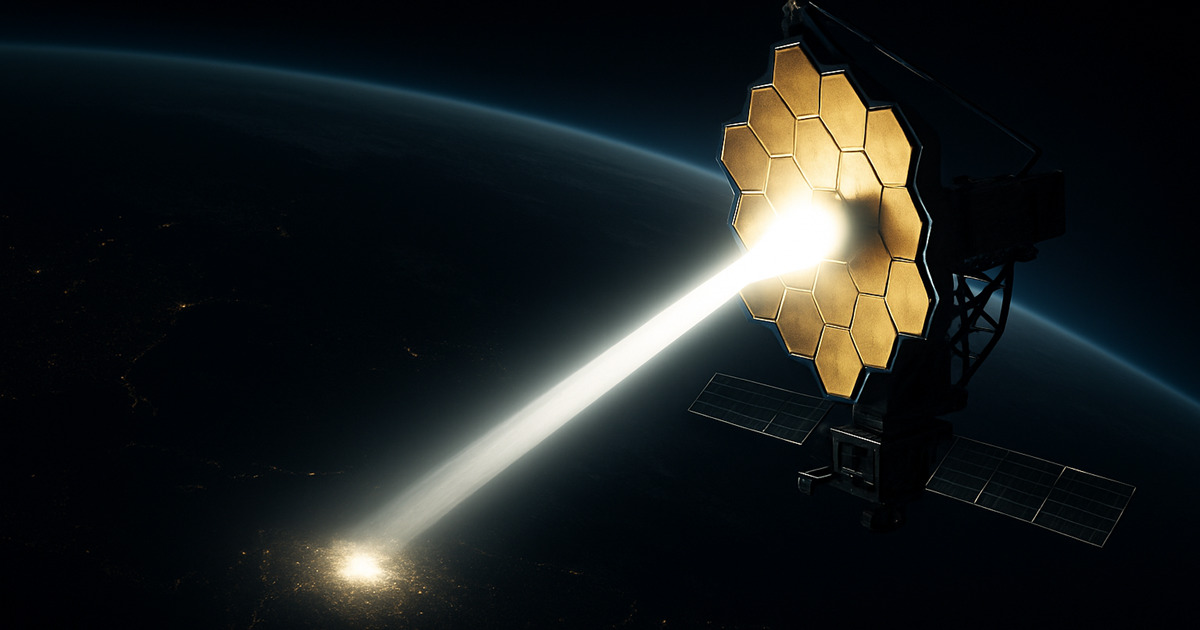
Imagine lying in bed at midnight. It is pitch black outside. You open an app on your phone, tap a location on a map, and five minutes later, a beam of pure sunshine blasts down from the sky, lighting up your backyard like it’s high noon.
This sounds like science fiction—or the plot of the James Bond movie Die Another Day. But in late 2025, a California startup called Reflect Orbital is moving fast to make it a reality.
They have raised millions of dollars to launch a constellation of thousands of giant mirrors into orbit. Their goal? To sell sunlight to anyone who wants it, even in the dead of night.
While tech enthusiasts are calling it the “ultimate green energy hack,” astronomers and environmentalists are calling it a potential disaster. Here is the deep-dive story behind the most controversial space project of the decade.
1. How The Technology Works: “Sunlight on Demand”
The concept is simple, but the engineering is audacious. Solar energy has one massive flaw: it stops working when the sun goes down. Currently, we use expensive batteries to store energy for the night.
Reflect Orbital wants to delete that problem entirely.
The Hardware: They plan to launch a fleet of satellites equipped with massive, ultra-reflective Mylar mirrors. These aren’t standard glass mirrors; they are made of a thin, lightweight polymer tightly stretched to create a perfect reflective surface.
- Size: Each mirror could unfold to be 60 feet (18 meters) wide.
- The Beam: The reflected light won’t illuminate the whole Earth. It focuses a tight beam of light, roughly 3 miles (5 km) wide, onto a specific target.
- Intensity: The light will reportedly be bright enough to generate electricity on solar panels, or provide “full moon plus” visibility for outdoor events.
By positioning these satellites in a Sun-Synchronous Orbit, they can stay bathed in sunlight while flying over the dark side of the Earth, angling their mirrors to “shoot” light down to customers below.
2. We Tried This Before: The Russian “Znamya” Project
Reflect Orbital isn’t the first to try this. In the 1990s, the Russians actually did it.
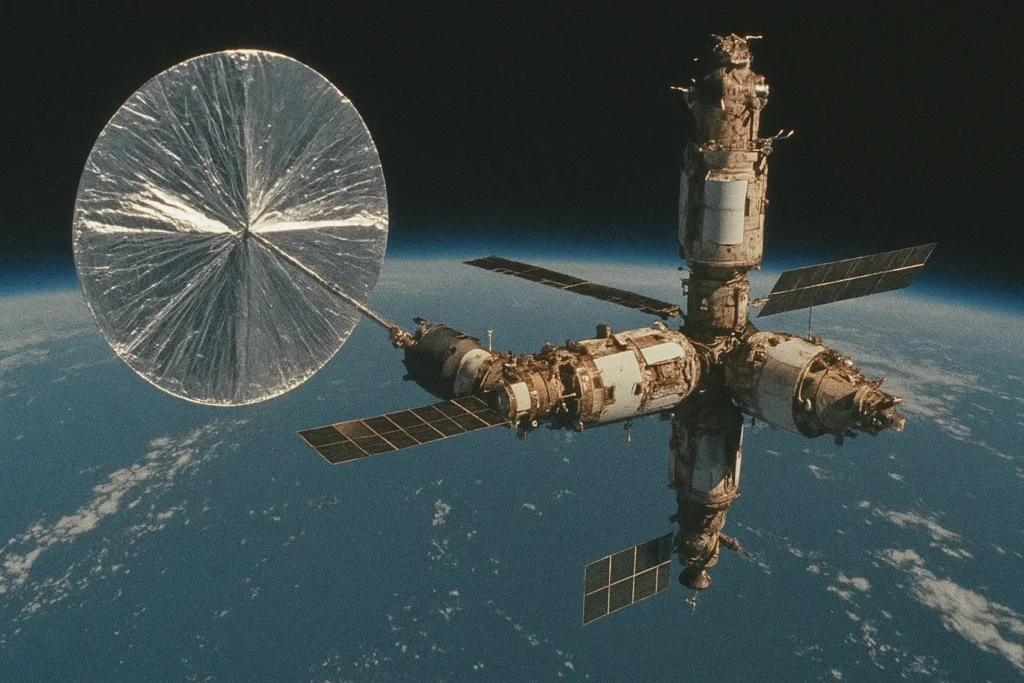
In 1993, Russian engineers launched Znamya-2, a 65-foot mirror attached to a Progress supply ship. When it unfurled in orbit, it successfully flashed a beam of light across Europe. People in France and Russia reported seeing a bright pulse of light moving across the sky.
However, the sequel, Znamya-2.5 (launched in 1999), ended in disaster. The mirror got tangled in an antenna on the space station and ripped apart. The project was scrapped due to lack of funding, but it proved the physics works. Reflect Orbital is essentially resurrecting this 30-year-old failed Soviet dream with modern technology.
3. The Business Model: Selling Light Like Uber
The company went viral earlier this year when CEO Ben Nowack demonstrated an app that supposedly allowed users to “order” a spotlight from space.
While the primary customers are utility companies, the “Use Cases” are wild:
- Solar Farms: Boosting energy production by 30-40% by extending daylight hours into the night.
- Disaster Relief: Lighting up earthquake zones or hurricane-hit areas where power grids have failed, aiding search and rescue teams.
- Entertainment: Outdoor festivals or sports stadiums that want natural lighting at 2:00 AM.
- Vanity: Wealthy individuals buying “5 minutes of sun” for a midnight garden party.
The company plans to launch its first major prototype, Earendil-1, as early as April 2026.
4. Why Astronomers Are Screaming
While Silicon Valley investors are cheering, the scientific community is horrified.
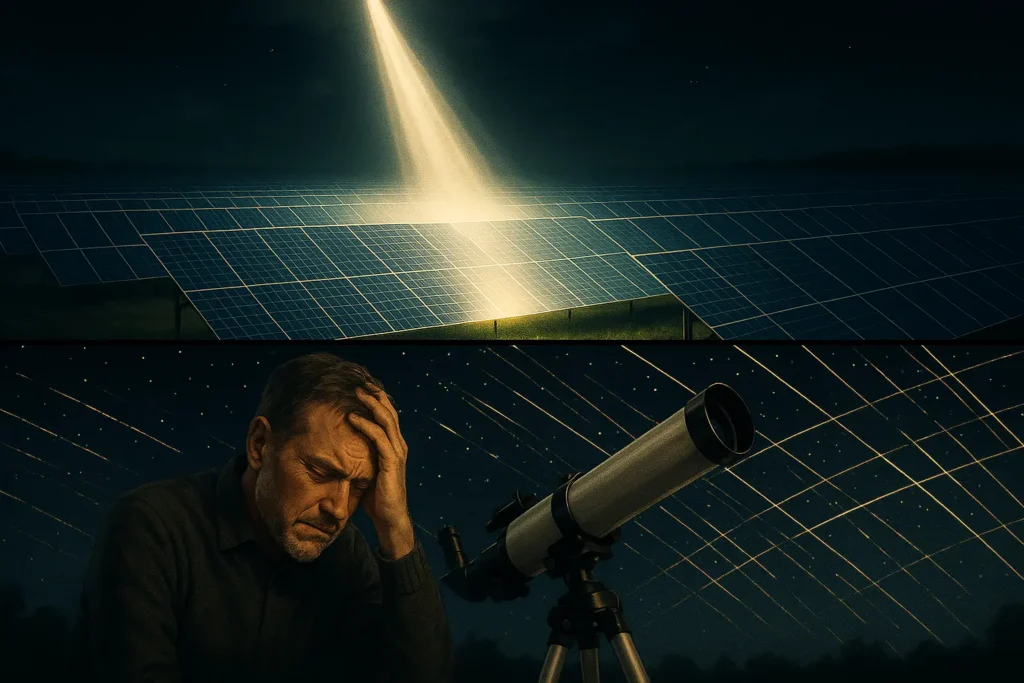
The night sky is already crowded with satellites (like SpaceX’s Starlink), which leave streaks in telescope images. But Reflect Orbital is different. These aren’t just reflecting light by accident; their entire purpose is to blast light at the Earth.
The “Artificial Star” Problem: To a person on the ground, these mirrors wouldn’t look like a beam (unless it was cloudy), but like an incredibly bright star—brighter than the full moon—streaking across the sky.
The Threat to Science: Leading astronomers warn that if 4,000 of these mirrors are launched, it could mark the end of ground-based astronomy.
- Vera C. Rubin Observatory: This massive new telescope in Chile is designed to scan the universe for faint objects. If thousands of “fake stars” are flashing overhead, it could ruin 40% or more of its data.
- Radio Interference: The electronics required to control these mirrors could also blast “noise” that disrupts radio telescopes listening for signals from deep space.
5. The Environmental Nightmare?
It’s not just about telescopes. Biologists are worried about the impact on nature.
Life on Earth has evolved for billions of years with a strict cycle of Day and Night.
- Migratory Birds: Many birds navigate by the stars. Bright, moving lights in the orbit could disorient them, leading to fatal crashes or lost flocks.
- Nocturnal Ecosystems: Insects, bats, and sea turtles rely on darkness. Introducing “fake daylight” could collapse local ecosystems, confusing pollinators and predators alike.
6. The Regulatory Battle Ahead
Reflect Orbital still has to get past the “Final Boss”: The US Government.
They have applied for a license from the FCC (Federal Communications Commission), but approval is not guaranteed. In the past, satellites were approved easily, but due to growing light pollution concerns, the FCC and FAA are under pressure to perform strict Environmental Impact Assessments.
There is a real chance that “Space Law” might step in to stop the project before it ever gets off the ground.
Conclusion
We are standing on the edge of a strange new future. Soon, looking up at the night sky might not mean seeing the stars—it might mean seeing a fleet of giant mirrors selling sunshine to the highest bidder.
Is this the genius breakthrough we need to solve the energy crisis? Or is it the ultimate form of pollution—stealing the night sky itself?
Fascinated by future tech? Read about the Spirograph Table invention or check out our Science section for more breakthroughs.