
In the 1940s, scientists at Los Alamos were building the atomic bomb. They were working with the most dangerous substances on Earth, often using safety procedures that would look insane today.
There was one specific sphere of plutonium—codenamed “Rufus”—that was responsible for two fatal accidents in less than a year.
After it claimed its second victim, the scientists stopped calling it “Rufus.” They renamed it The Demon Core.
Here is the terrifying story of the object that killed anyone who messed with it.
1. The First Victim: Harry Daghlian (1945)
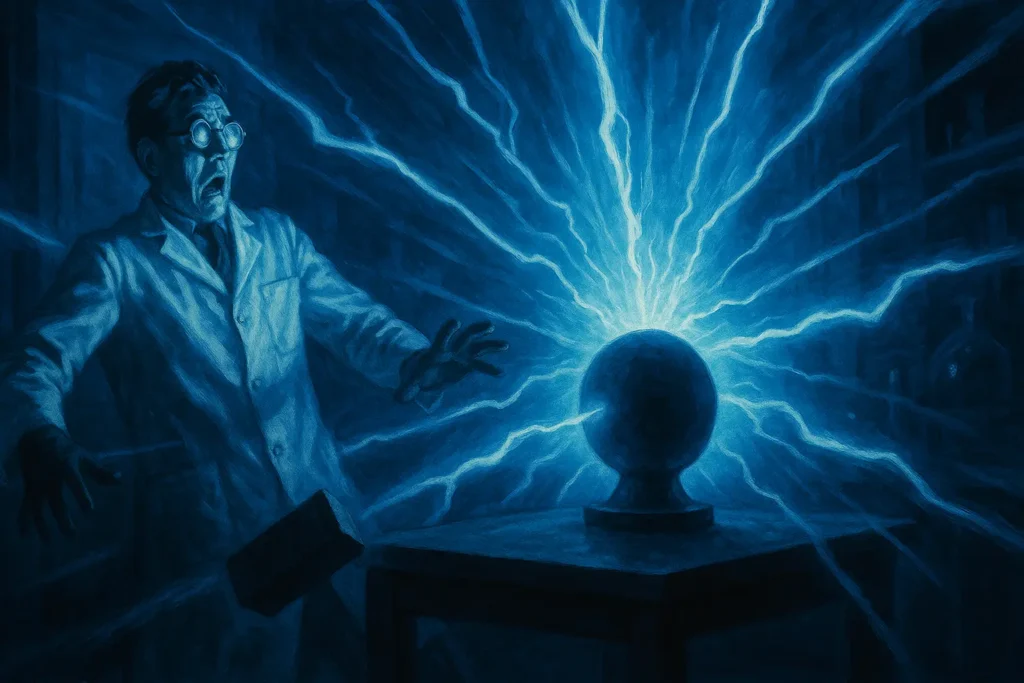
The first accident happened on August 21, 1945. Physicist Harry Daghlian was working alone at night (a violation of safety rules).
He was building a wall of tungsten carbide bricks around the plutonium core to reflect neutrons back into it, pushing it closer to a “critical state.” As he was placing a brick, it slipped from his sweaty hand and fell directly onto the core.
The Blue Flash: Instantly, the room filled with a bright flash of blue light (Cherenkov radiation). The core had gone supercritical. Daghlian panicked and knocked the brick off with his bare hand, stopping the reaction. But it was too late. He had absorbed a lethal dose of radiation and died a gruesome death 25 days later.
2. The Second Victim: Louis Slotin (1946)
You would think the scientists would learn. But nine months later, Louis Slotin, a brilliant but reckless physicist, was performing an experiment known as “Tickling the Dragon’s Tail.”
Slotin wanted to bring the core as close to criticality as possible without causing an explosion. To do this, he placed two beryllium half-spheres around the core. He used the tip of a standard flathead screwdriver to hold the top shell open by just a tiny fraction of an inch.
If the shell closed, the core would go critical. His life depended entirely on his steady hand holding a screwdriver.
3. The Screwdriver Slipped
On May 21, 1946, Slotin was showing off the technique to seven other scientists in the room. Suddenly, the screwdriver slipped.
The top shell clamped shut.
The Second Blue Flash: Once again, the room was bathed in a blinding blue light. The scientists felt a wave of heat wash over them. Slotin jerked his hand up, flipping the shell off and stopping the reaction instantly. He saved the other men in the room, but he had looked directly into the face of the “Demon.”
He reportedly told his colleagues, “Well, that does it,” knowing he was a dead man. He died in agony nine days later.
4. The End of the Cowboy Era
The death of Louis Slotin changed everything.
The laboratory banned “hands-on” experiments immediately. From then on, all manipulation of radioactive cores was done by remote-controlled robot arms from behind thick shielding.
The Demon Core itself was never used in a bomb. It was melted down and recycled into other cores, but its legacy remains as a cautionary tale of what happens when human arrogance meets the invisible power of the atom.

Conclusion
The Demon Core was only 3.5 inches wide—about the size of an orange. It looked harmless. But it serves as a reminder that in the world of nuclear physics, the line between “safe” and “dead” is often just the width of a screwdriver tip.



2 Comments on “The Demon Core: The Deadly Screwdriver Incident”