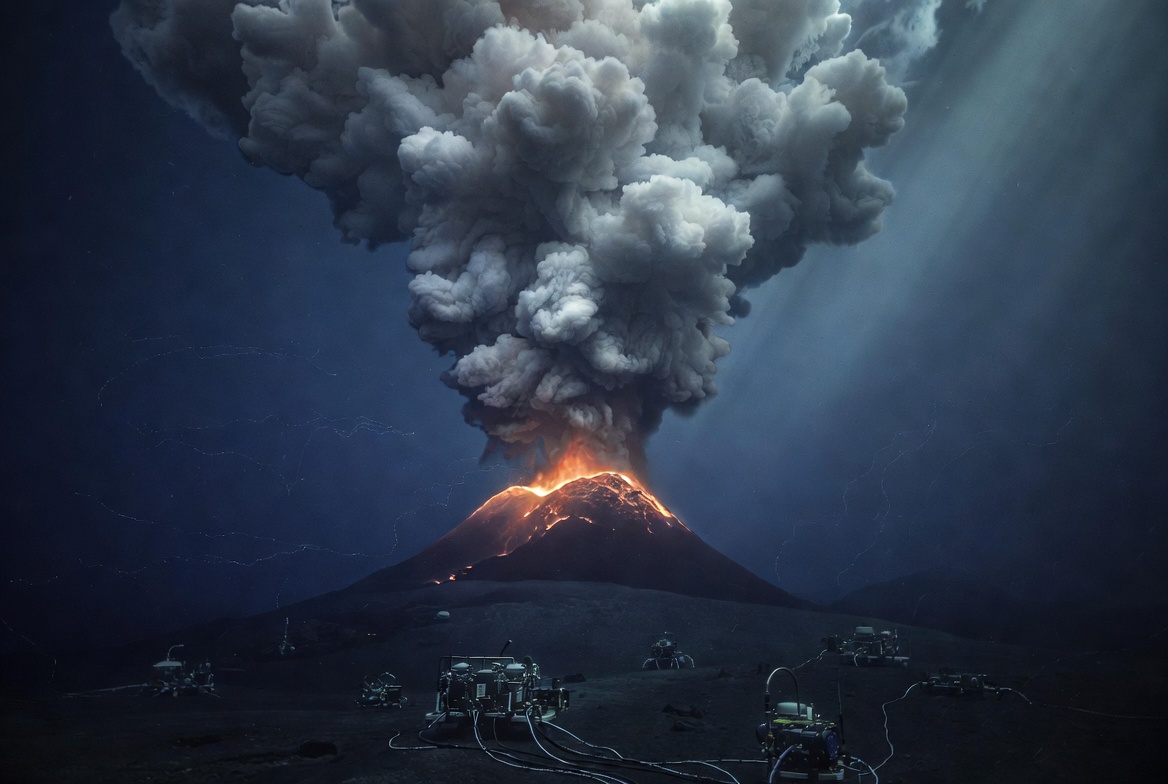
Imagine a colossal volcano lurking 1,500 meters (nearly a mile) beneath the ocean’s surface, quietly inflating like a balloon filled with molten rock. This isn’t the plot of a disaster movie—it’s the real-life story of Axial Seamount, a submarine giant off the coast of Oregon that’s captured the attention of scientists worldwide. As we step into 2026, experts are watching closely, predicting that this year could finally see the volcano burst forth in a spectacular underwater eruption. But how do we know? And what makes this hidden behemoth so predictable—or unpredictable? Let’s dive into the fascinating tale of Axial Seamount, where cutting-edge science meets the raw power of Earth’s geology. Because facts have stories, and this one is bubbling with intrigue.
The Discovery of a Submarine Giant: Axial Seamount’s Origins
Axial Seamount’s story begins millions of years ago, but its modern chapter started in the late 1970s when oceanographers first mapped this underwater mountain. Located about 480 kilometers (300 miles) west of Cannon Beach, Oregon, Axial sits atop the Juan de Fuca Ridge, a divergent tectonic plate boundary where the Pacific and Juan de Fuca plates pull apart. This hotspot of volcanic activity makes it part of the Pacific Ring of Fire, though far from the dramatic peaks like Mount St. Helens that dominate headlines.
Named for its position at the axis of the Cobb-Eickelberg Seamount chain, Axial isn’t your typical volcano. It’s a shield volcano, similar to Hawaii’s Mauna Loa, but entirely submerged. Rising 1,100 meters (3,600 feet) from the seafloor, its caldera—a massive crater left by previous collapses—measures 3 by 8 kilometers (2 by 5 miles). What sets Axial apart is its hyperactivity: it’s the most active volcano in the Northeast Pacific, erupting more frequently than most land-based counterparts.
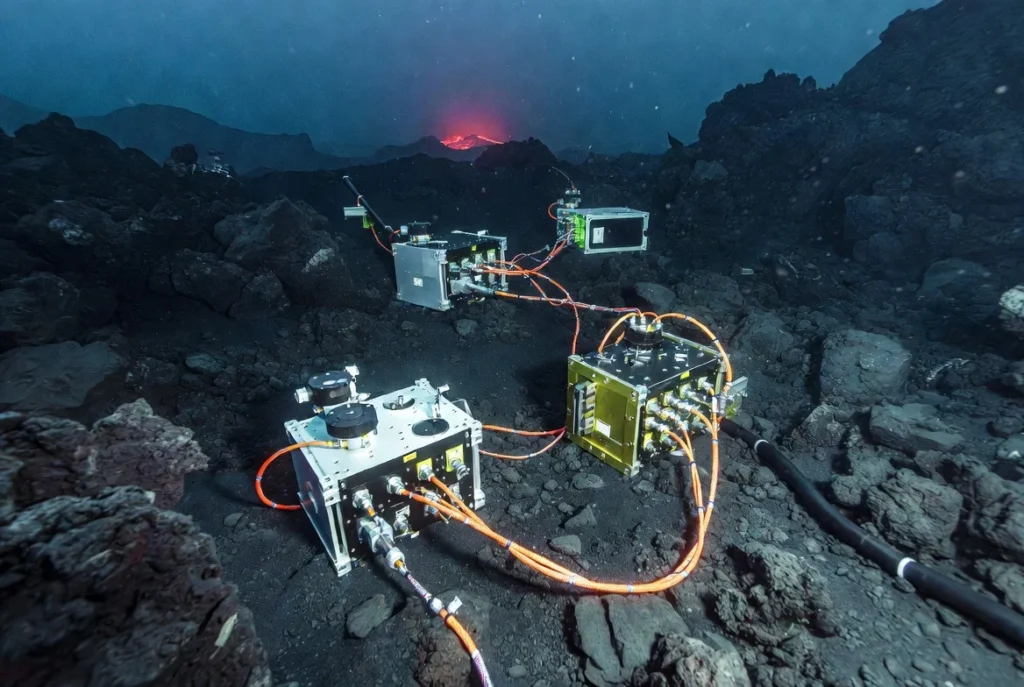
The first hints of its volatility came in 1998 when it erupted, spewing lava flows that reshaped the seafloor. But it was the 2011 and 2015 eruptions that turned Axial into a scientific superstar. During the 2015 event, researchers captured real-time data for the first time, thanks to the Ocean Observatories Initiative (OOI) Regional Cabled Array—a network of underwater instruments connected by fiber-optic cables to shore-based labs. This setup provides continuous streams of seismic, pressure, and deformation data, making Axial the most well-monitored submarine volcano on Earth.
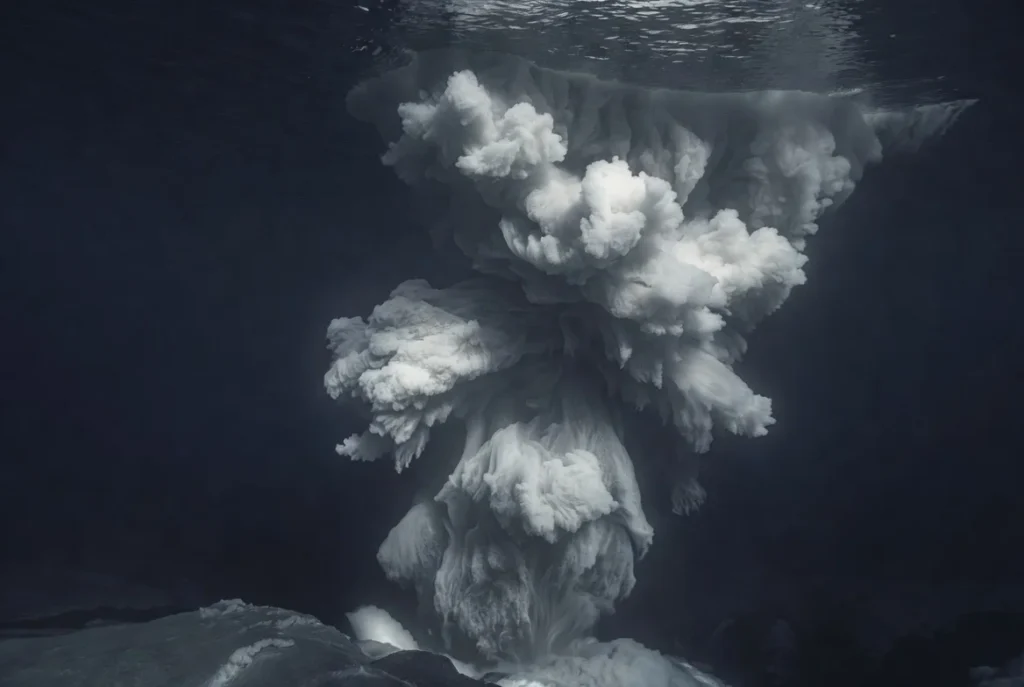
Fun fact: Axial’s eruptions don’t cause tsunamis or ash clouds like surface volcanoes. Instead, they create “megaplumes”—massive hydrothermal vents that release superheated water rich in minerals, fostering unique ecosystems teeming with tube worms, bacteria, and other extremophiles. These plumes can rise thousands of meters into the ocean, dispersing chemicals that influence global ocean chemistry.
The Science of Prediction: How Scientists Forecast Underwater Eruptions
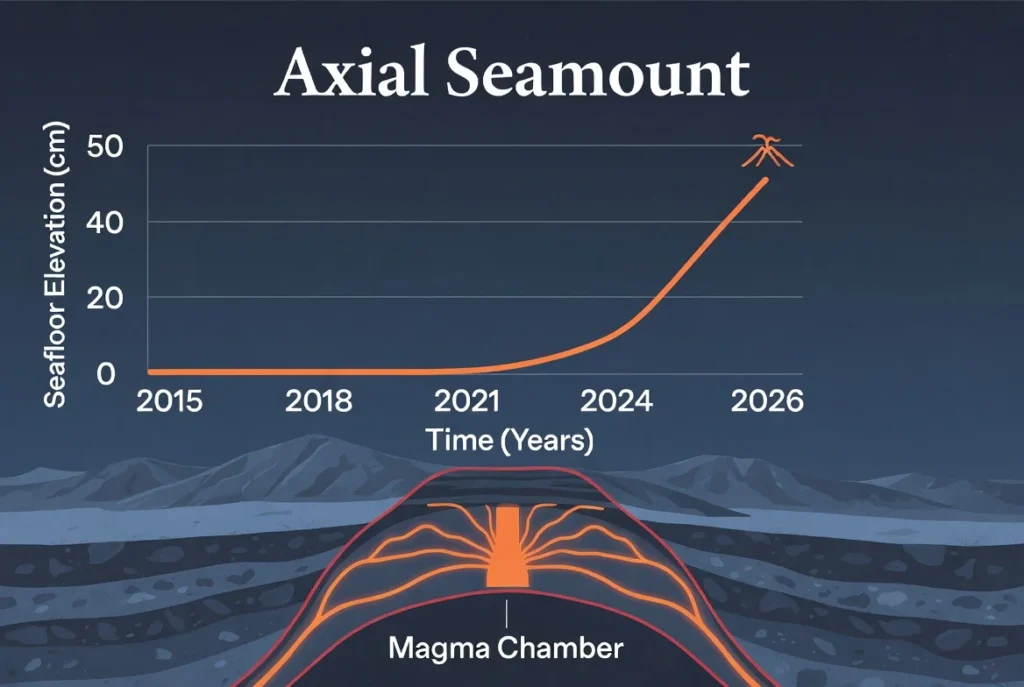
Predicting volcanic eruptions is notoriously tricky—think of the surprises from Iceland’s Eyjafjallajökull in 2010 or Hawaii’s Kilauea in 2018. But Axial Seamount offers a rare opportunity for accuracy, thanks to its accessible location and advanced monitoring. The key lies in “inflation,” where magma accumulates in a reservoir beneath the caldera, causing the seafloor to bulge upward like a inflating tire.
Scientists measure this deformation using bottom pressure recorders and tiltmeters. Before the 2015 eruption, the seafloor rose by about 2.4 meters (8 feet) over several years. Post-eruption, it deflates rapidly as magma is expelled, then begins reinflating. By tracking this cycle, researchers like Bill Chadwick from Oregon State University and William Wilcock from the University of Washington have developed models to forecast when the next blow might occur.
In April 2025, inflation levels matched those preceding the last three eruptions (1998, 2011, 2015), sparking excitement. “It could really erupt any day now,” Wilcock noted at the time. Seismic activity ramps up too—earthquakes swarm as rocks fracture under pressure. In 2015, quakes peaked at over 2,000 per day in the months leading up, dropping to a hush just before the eruption.
But nature loves curveballs. By October 2025, inflation slowed, and earthquake counts hovered at a modest 100-1,000 per day—far below eruption thresholds. Chadwick updated the forecast on the Axial Blog: “At the current rate, we won’t reach the higher threshold until mid-to-late 2026.” This adjustment highlights the challenges: inflation rates fluctuate, possibly due to varying magma supply from the mantle or changes in the reservoir’s elasticity.
Adding another layer, tidal forces from the Moon and Sun may play a role. Ocean tides press on the crust, influencing earthquake rates. Researcher Maya Tolstoy explained that low tides reduce pressure, potentially triggering more quakes. Notably, Axial’s recent eruptions all happened between January and May, when solar gravitational pull is weakest. Could 2026’s early months align for a perfect storm?
A new twist comes from a physics-based model by Qinghua Lei and Didier Sornette, tested in real-time starting late 2025. This model, applicable to landslides, glaciers, and volcanoes, uses mechanical failure principles to predict breakdowns. Chadwick is optimistic: “I’m looking forward to seeing how well it works, particularly in comparison to our subjective attempts at forecasting based on pattern-recognition.”
Past Eruptions: Lessons from the Deep
Axial’s eruption history reads like a geological thriller. The 1998 event was detected retrospectively through seismic data and lava sampling. It covered 9 square kilometers (3.5 square miles) with fresh basalt, but without real-time monitoring, much was missed.
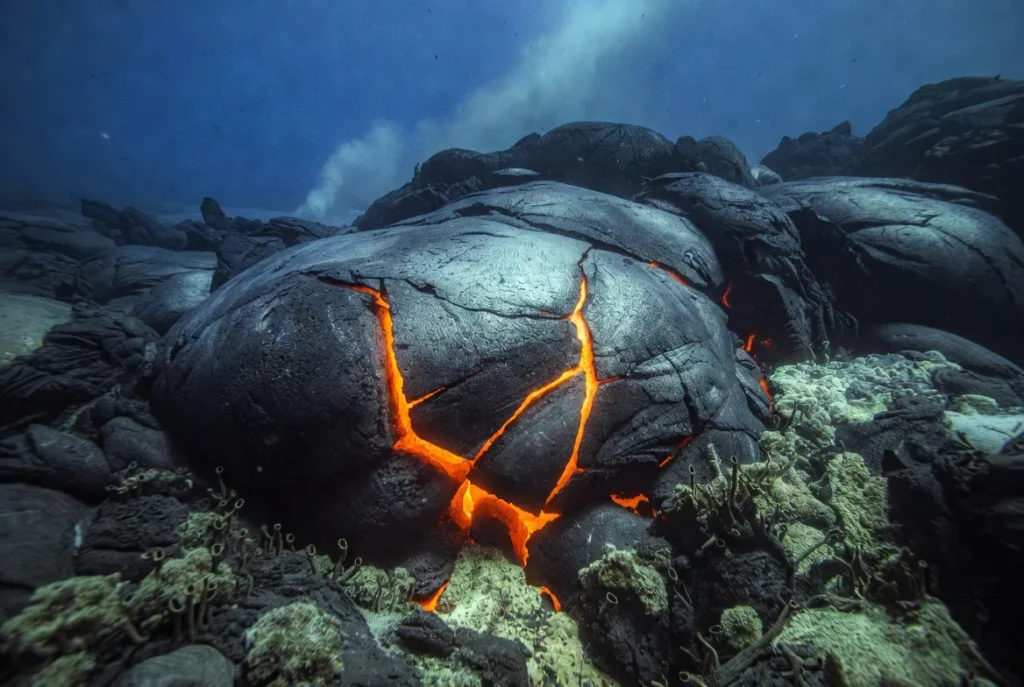
The 2011 eruption was a game-changer. Just months after the OOI array’s installation, sensors captured the drama: 8,000 earthquakes in 24 hours, followed by a 2.4-meter deflation in six hours. Lava flows extended 3 kilometers (2 miles) from the caldera, creating pillow basalts—rounded lava formations resembling stacked cushions.
Then came 2015, the most documented submarine eruption ever. Inflation had built steadily since 2011, culminating in April with a swarm of 600 earthquakes per hour. The eruption lasted days, extruding enough lava to pave a highway from New York to San Francisco. Megaplumes shot up 2 kilometers (1.2 miles), carrying heat equivalent to a year’s worth of U.S. electricity production.
These events teach us about Earth’s inner workings. Axial’s magma is basaltic—runny and hot (up to 1,200°C or 2,200°F)—allowing frequent, effusive eruptions rather than explosive ones. Each cycle refines our understanding: post-2015, the reservoir refilled faster than expected, suggesting a robust mantle supply.
Implications extend beyond geology. Studying Axial helps predict hazards at similar sites, like the Loihi Seamount near Hawaii, which could one day emerge as a new island. It also informs climate models, as submarine volcanoes release CO2 and other gases, contributing to ocean acidification.
What If It Erupts in 2026? Scenarios and Impacts
If predictions hold, a 2026 eruption would be a scientific bonanza. No danger to humans—it’s too deep for surface effects—but the data could revolutionize volcanology. Imagine live feeds of lava flowing across the seafloor, captured by underwater robots like those from the University of Washington’s VISIONS program.
Potential scenarios: A mild effusion, adding new lava fields, or a more vigorous event with larger megaplumes. Earthquakes might intensify weeks prior, giving a heads-up. Chadwick’s blog will track it all, turning citizen scientists into virtual witnesses.
Broader impacts? Enhanced ocean fertility from mineral-rich plumes, boosting microbial life. But in a warming world, extra CO2 isn’t ideal—though Axial’s output is a drop in the bucket compared to human emissions.
Curiosity alert: Axial hosts “black smokers”—chimneys spewing 400°C (750°F) water, home to blind shrimp and giant clams. Post-eruption, these ecosystems rebound quickly, offering insights into life’s resilience, perhaps even analogs for extraterrestrial habitats on icy moons like Europa.
The Human Element: Scientists on the Edge
Behind the data are passionate researchers who’ve turned Axial into a lifelong pursuit. Chadwick, a veteran seafloor mapper, blogs updates with the enthusiasm of a storyteller. Wilcock, focused on seismic networks, sees Axial as a “natural laboratory.” Their work, funded by NSF and NOAA, exemplifies collaborative science.
Challenges abound: Harsh ocean conditions damage instruments, and funding fluctuations threaten continuity. Yet, optimism prevails. As Deborah Kelley noted, “If what we learned in 2015 is correct, I would expect to see more than 2,000 earthquakes per day for a few months before the eruption.”
Why Axial Seamount Captures Our Imagination

In a world of visible threats, Axial reminds us of hidden wonders. It’s a story of patience—Earth’s slow rhythms clashing with our instant-gratification era. Predictions may shift (to 2027?), but the pursuit sharpens our tools for understanding planetary processes.
As 2026 unfolds, keep an eye on the Axial Blog or OOI dashboards. Who knows? This year might deliver the next chapter in this underwater saga. Facts like these aren’t just data points—they’re narratives of our dynamic planet, waiting to be told.