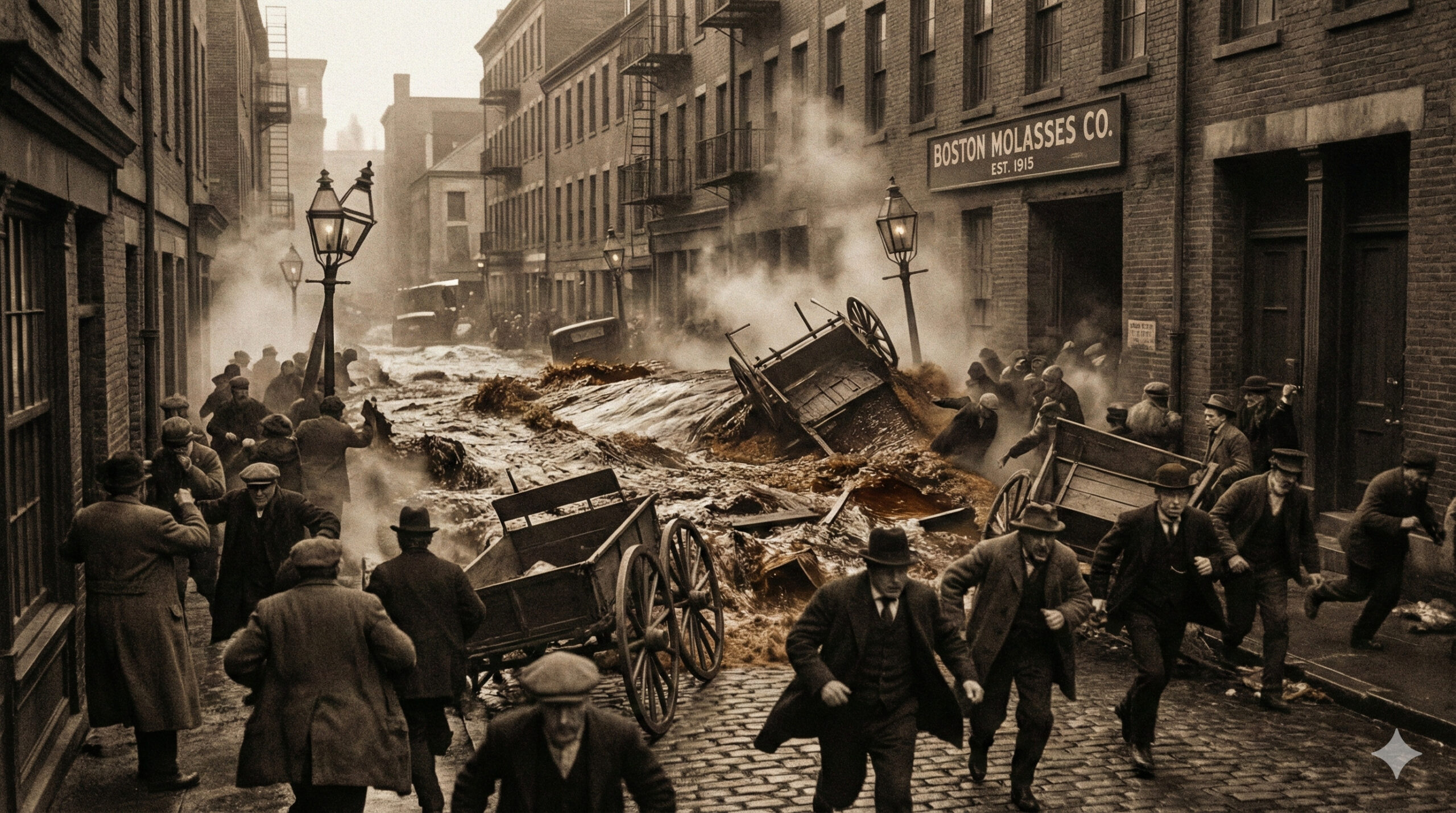
If you hear the phrase “death by chocolate” or “drowning in sugar,” you probably think of a decadent dessert menu. But for the residents of Boston’s North End in 1919, these weren’t metaphors. They were a nightmare.
We often think of disasters involving fire, water, or earthquakes. But The Great Molasses Flood of January 15, 1919, stands as one of the strangest and most tragic events in American history. It proves that even the most innocent household ingredients can turn deadly under the right laws of physics.
Here is the true story of the day a wave of syrup moved faster than a car, leveled a neighborhood, and changed American law forever.
1. The Rush for Alcohol: Why the Tank Was Full
To understand the disaster, you have to understand the date. It was January 1919. The 18th Amendment (Prohibition) had been ratified and was set to ban alcohol production in just one year.
The Purity Distilling Company (a subsidiary of United States Industrial Alcohol) was in a race against time. They needed to turn as much molasses into industrial alcohol and rum as possible before the ban took effect.
They had built a monstrous steel tank at 529 Commercial Street. It was a titan: 50 feet tall (15 meters) and 90 feet in diameter. On the day of the disaster, it was filled to the brim with 2.3 million gallons of molasses.
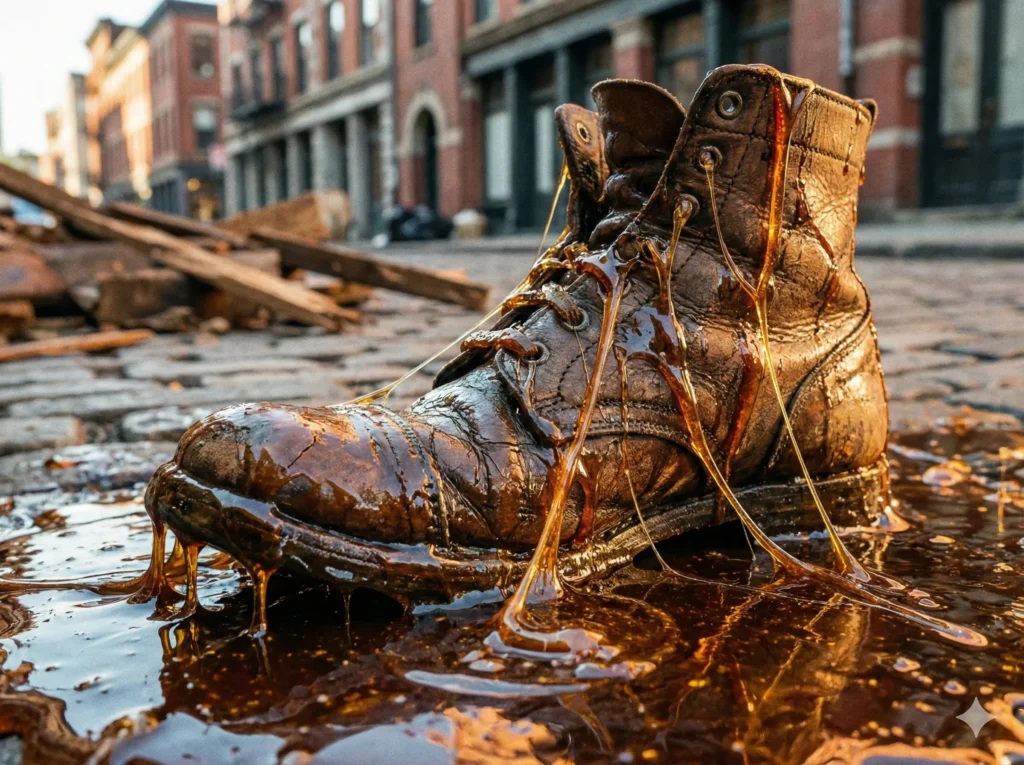
But the tank was a ticking time bomb. It had been built hastily with insufficient oversight. Locals knew it was dangerous; the tank groaned and shuddered when filled. It leaked so badly that the company painted the entire tank brown to hide the sticky streaks running down the sides. Neighborhood children would often sneak up with cups to collect the sweet drippings—a treat that would soon turn deadly.
2. The Explosion: “A Sound Like Machine Guns”
January 15th was unseasonably warm—40°F (4°C) compared to the freezing days prior. The thermal expansion of the cold molasses inside the warming steel tank proved to be the final straw.
At approximately 12:41 PM, the neighborhood was eating lunch. Suddenly, witnesses reported a low rumble, followed by a sound described as “rat-tat-tat”—like a machine gun.
It wasn’t gunfire. It was the sound of thousands of steel rivets shooting out of the tank walls.
The steel panels peeled open. The tank didn’t just leak; it disintegrated. The collapse created a vacuum so powerful it sucked a nearby truck across the street. Then, the wave hit.
3. Tsunami of Syrup: The Deadly Physics
When we think of molasses, we think of the idiom “slow as molasses in January.” We imagine a thick, harmless sludge.
But physics tells a different story. Because of the sheer height of the fluid column and the density of molasses (which is 40% heavier than water), the potential energy converted into kinetic energy instantly.
The molasses formed a wave 25 feet high (7.6 meters) that surged through the streets at 35 mph (56 km/h).
This wasn’t a liquid; it was a battering ram.
- Destruction: The wave knocked a firehouse off its foundation. It crushed freight trains as if they were made of aluminum foil. An elevated railway structure was snapped in half.
- The Trap: As the wave settled, the air temperature began to drop. The molasses, which had been heated to flow, began to cool rapidly. This increased its viscosity (thickness). Victims weren’t just drowning; they were trapped in amber. The harder they struggled, the deeper they sank.
4. The Human Toll and the Rescue
The disaster was devastating. 21 people were killed and 150 were injured.
The rescue effort was grotesque. Medics and firefighters found it nearly impossible to reach victims because they would get stuck in the waist-deep goo themselves. Horses, trapped in the sticky mire, could not be pulled out and had to be shot by police to end their suffering.
The cleanup took weeks. Fresh water had no effect on the hardened syrup. Firefighters eventually had to use salt water pumped from the harbor by fireboats to cut through the slime. The harbor water remained brown for months.
5. The “Anarchist” Defense & The Trial That Changed History
This is the part of the story most people forget. The Purity Distilling Company did not apologize. Instead, they claimed they were victims of terrorism.
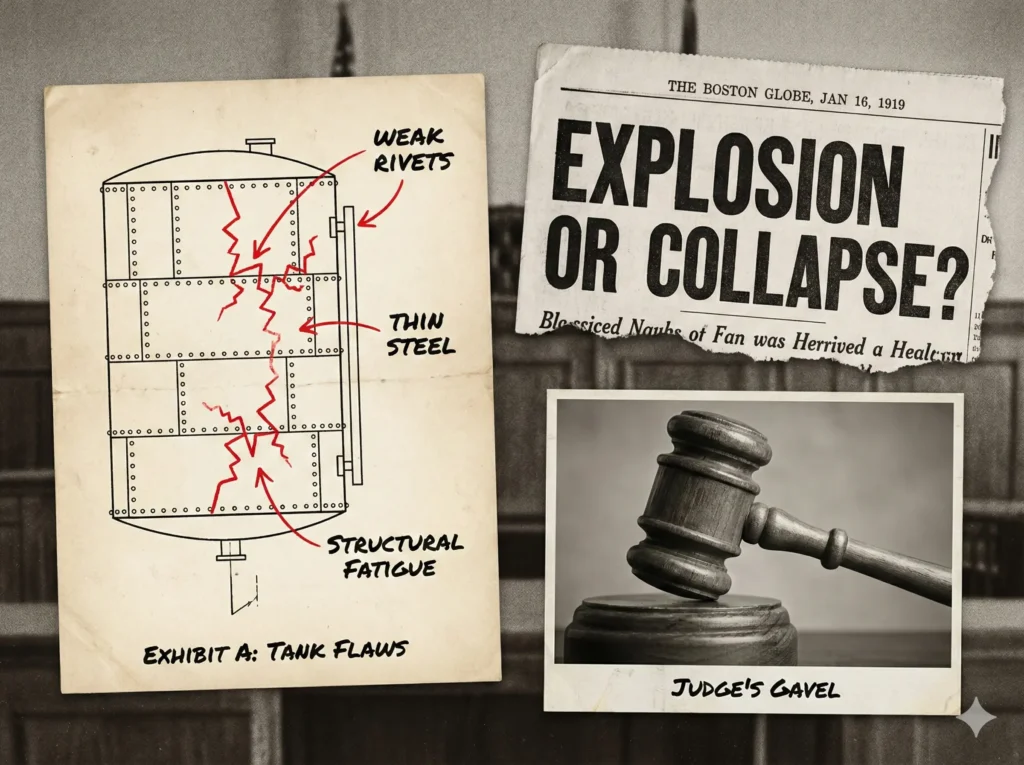
Because it was 1919 (a time of political unrest and anarchist bombings), the company claimed that “Italian Anarchists” had planted a bomb in the tank. They launched a massive PR campaign to deflect blame.
The resulting lawsuit was one of the longest in Massachusetts history. It involved over 3,000 witnesses and produced 45,000 pages of testimony.
- The Verdict: The court appointed a special auditor, Colonel Hugh Ogden. After years of reviewing the science, he ruled that there was no bomb. The cause was structural failure. The steel was too thin, and the rivets were overstressed.
- The Legacy: This ruling established the precedent that architects and engineers are liable for the safety of their structures. Every building code in America today owes a debt to the Molasses Flood.
6. The Sweet Smell of Ghosts
Today, the site of the disaster is a recreational park in Boston’s North End (Langone Park). A small plaque marks the event.
But folklore insists the story isn’t over. For decades, North End residents claimed that on hot, humid summer days, you could still smell the faint, sickly-sweet scent of molasses rising from the cracks in the pavement and the old brickwork.
It serves as a sensory reminder that history is not always written in ink and blood. Sometimes, it is written in sugar.