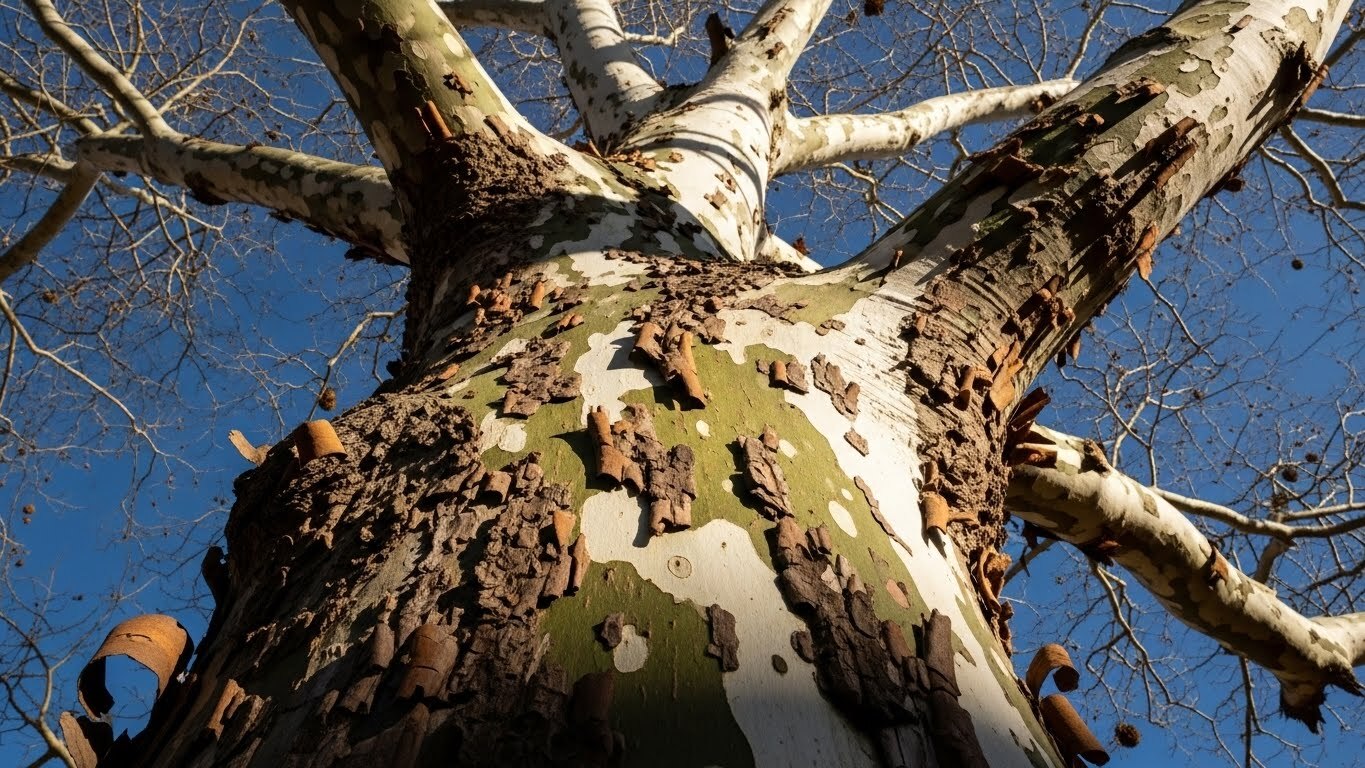
If you walk through a winter forest near a river, you will see it immediately. Among the dark browns and greys of oaks and maples, one tree stands out like a bright white skeleton.
It is the American Sycamore (Platanus occidentalis).
Known as the “Ghost of the Forest” because of its bone-white branches, this tree is a biological oddity. It sheds its skin like a reptile, it can live while completely hollow, and it played a surprising role in the history of global finance.
Here are 5 interesting facts about the tree you might have walked past a thousand times.
1. It Sheds Its Skin Like a Snake
The most famous feature of the Sycamore is its “camouflage” bark. As you look up the trunk, the rough brown bark peels away to reveal patches of green, tan, and eventually smooth, creamy white.
Why does it do this? Most tree bark is elastic—it stretches as the tree grows. Sycamore bark is rigid and brittle. As the massive trunk expands (and Sycamores grow fast), the bark literally bursts open and falls off because it can’t stretch.
- Bonus Benefit: By shedding its bark, the Sycamore also sheds parasites, moss, and pollution that try to latch onto it, keeping the tree “clean.”
2. Wall Street Started Under a Sycamore
This is the most famous business deal in history.
In the late 1700s, New York City was the capital of the US, and stockbrokers were trading shares of banks and lotteries in chaotic auctions. They needed rules.
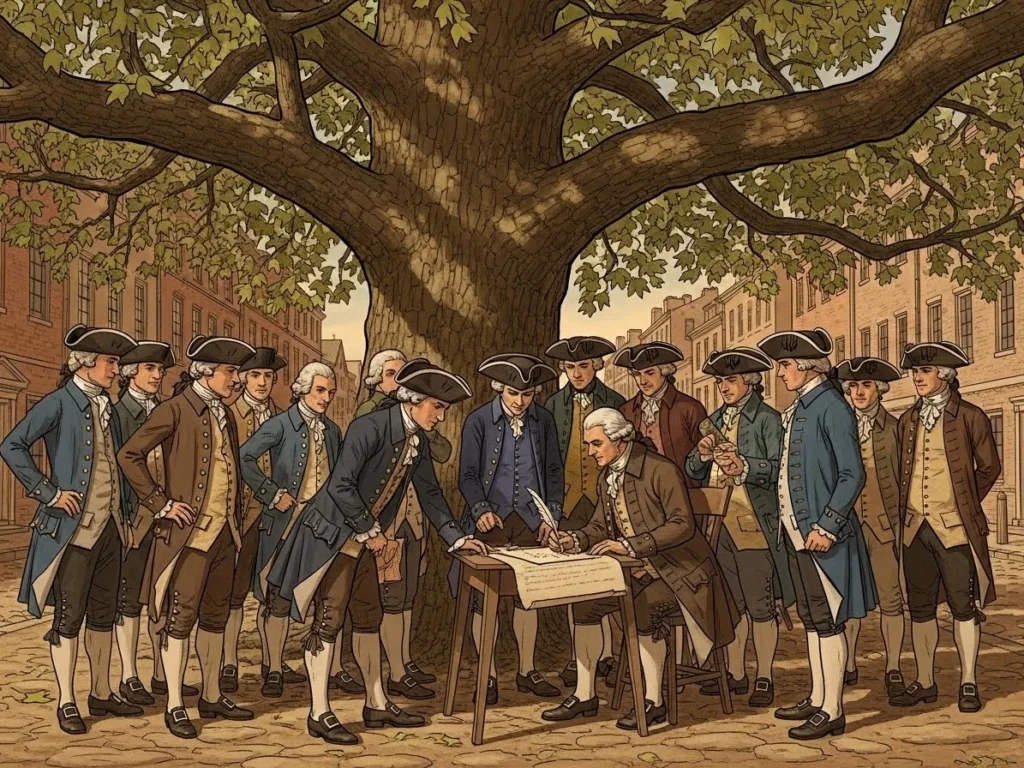
On May 17, 1792, 24 stockbrokers met outside 68 Wall Street. They stood under the shade of a massive Sycamore tree (which was called a “Buttonwood” tree back then) and signed a document setting standard commission rates. They called it The Buttonwood Agreement. That agreement evolved into the New York Stock Exchange (NYSE). So, the world’s largest financial market owes its existence to the shade of a Sycamore.
3. The “Moon Trees” Are Sycamores
In 1971, astronaut Stuart Roosa launched with the Apollo 14 mission to the moon. In his personal kit, he carried hundreds of seeds. Many of them were Sycamore seeds.
They orbited the moon 34 times and returned to Earth. Scientists planted them to see if zero gravity affected their growth. These “Moon Trees” were planted all over the United States. Many are still growing today, living monuments to the space race.
4. They Are Nature’s “Apartment Complex”
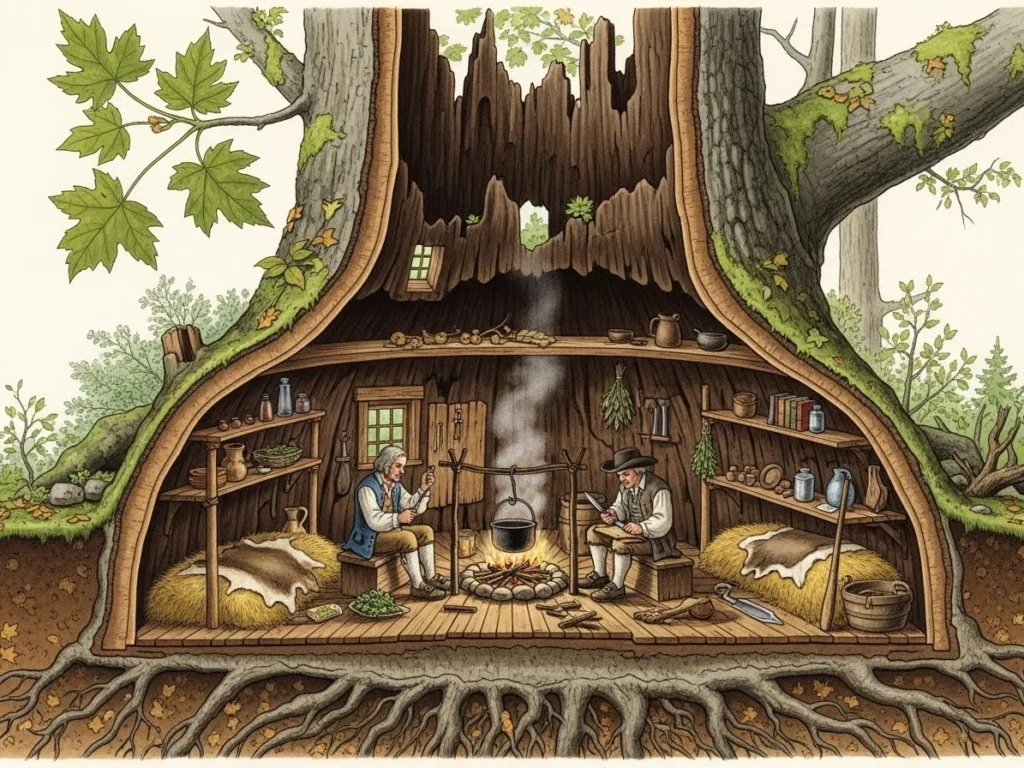
Sycamores have a unique habit: as they get old, they often rot from the inside out. While this kills most trees, the Sycamore is tough. It can survive for centuries with a completely hollow trunk, supported only by its outer shell.
These hollows become massive homes.
- The Pringle Tree: In the 1760s, two brothers (John and Samuel Pringle) deserted the British army and lived inside a hollow Sycamore tree in West Virginia for three years. The cavity was so big it reportedly had enough room for their beds and a fireplace.
5. The “Buttonballs” Stay All Winter
How do you spot a Sycamore in January? Look for the ornaments. While other trees drop their seeds in autumn, the Sycamore holds onto its fruit—tough, spikey balls about the size of a ping-pong ball.
They hang from the white branches on thin stems, looking like Christmas ornaments. In the spring, these “Buttonballs” explode into fluff, releasing thousands of seeds to the wind.
Conclusion
The Sycamore is loud, messy, and beautiful. It grows fast, sheds its bark on your lawn, and drops spiky balls on your driveway. But it is also a survivor—a tree that can house humans in its belly and whose shade birthed the modern economy.
Love nature stories? Read about the Reindeer with Blue Eyes or explore our Nature section.