It is the first tool we learn to use as babies, often grasped in a clumsy fist, and it is frequently the last tool we rely on in old age. It is the most intimate object in your house—a tool you put inside your sensitive mouth every single day.
But have you ever stopped to look—really look—at a spoon?
In our modern world of stainless steel and disposable plastic, we have lost touch with the roots of this essential object. But the history of the spoon is not just about eating soup. It is a chronicle of human survival, a marker of social class (“born with a silver spoon”), a vessel for ancient superstition, a musical instrument, and, surprisingly, a tool of seduction.
From the frozen forests of Scandinavia to the coasts of Wales and the villages of Russia, here is the untold, definitive story of the spoon.
1. The “Chip of Wood”: An Ancient Necessity
If you look at the etymology (the origin of words), the history of the spoon is written in its name. The English word spoon is derived from the Old English spon and the Proto-Germanic spōniz, which literally translates to “a chip of wood” or “splinter.”
This linguistic clue tells us everything we need to know about the first spoons. Long before the Bronze Age or the Iron Age, early humans needed a way to consume hot liquids. You cannot drink boiling broth from your hands.
Nature’s Spoons: Before Carving
Before humans mastered tools, they used what nature provided:
- Sea Shells: In Southern Europe and coastal regions, clams and conch shells were used attached to sticks. The Greek word for spoon, kochlarion, comes from cochlea (spiral shell).
- Horns and Bone: In colder climates, animal horns and hollow bones served as scoops.
- Bread: In many ancient cultures, thick, stale bread was used to scoop up stew. When the meal was done, you ate the spoon. This tradition actually survives today in the form of “trenchers” or edible bread bowls.
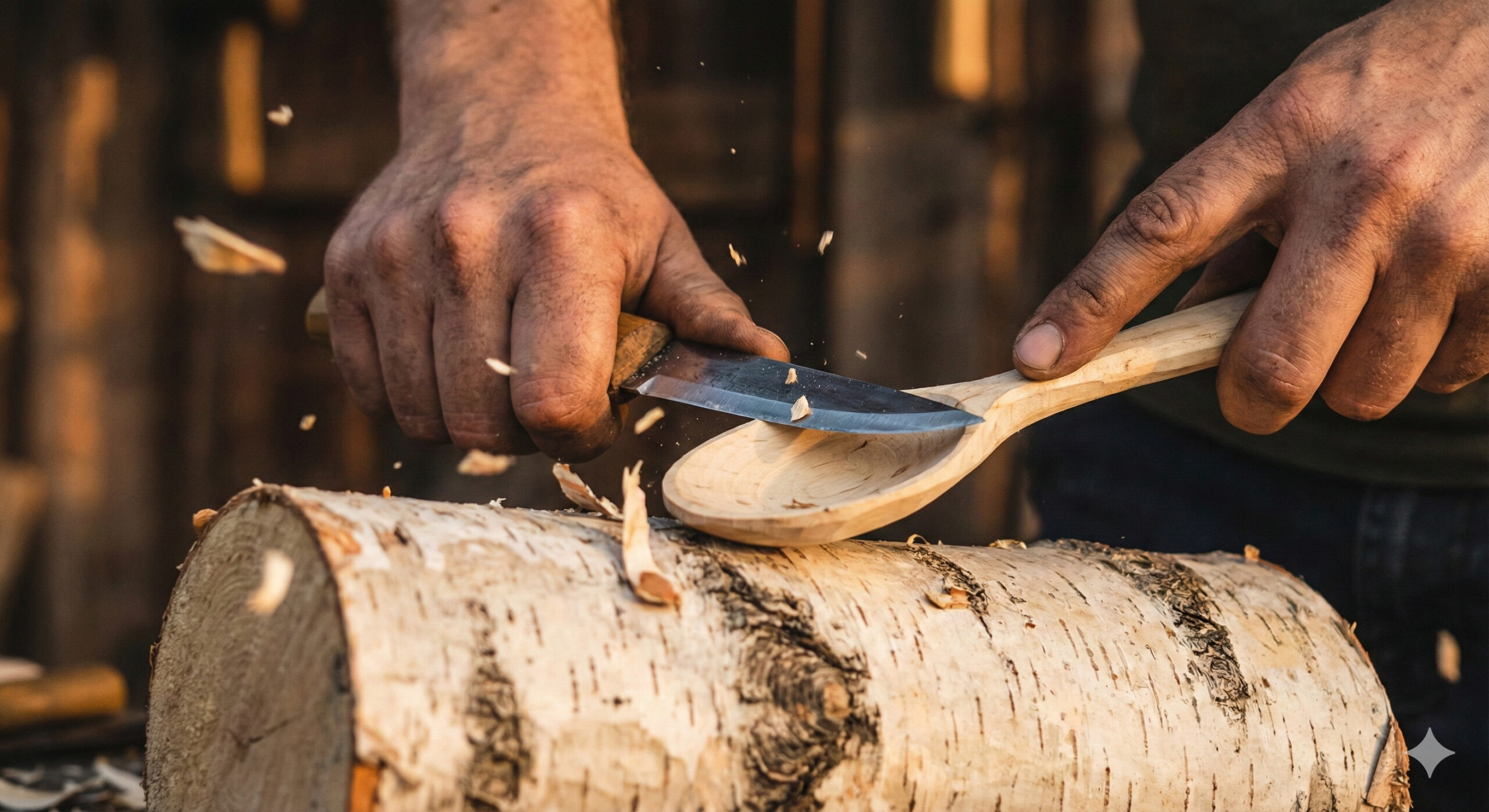
Eventually, humans realized they could shape nature to their will. Using sharp stones and later metal knives, they fashioned the first true spoons from the branches of trees.
2. The Anatomy of a Spoon
To understand the history, you have to speak the language. A spoon isn’t just one piece; historically, it has three distinct parts that carvers have obsessed over for centuries:
- The Bowl: The scoop part. In the Middle Ages, this was often fig-shaped (wide near the handle, narrow at the tip). It only became oval/egg-shaped in the Victorian era.
- The Neck (or Throat): The transition point between the bowl and the handle. This is the “weak point” where a spoon usually breaks, and where a master carver shows their skill.
- The Finial: The decorative tip of the handle. In medieval times, this was the most important part. Wealthy people would have “Apostle Spoons” with tiny statues of the 12 apostles carved on the finial.
3. The Class Divide: Wood vs. Silver
For most of human history, the material of your spoon dictated your status in society. This is the origin of the famous idiom: “Born with a silver spoon in one’s mouth.”
In Medieval and Tudor Europe, metal was expensive. Only the aristocracy and royalty ate with silver or pewter. The metal spoon was a status symbol, often given as a christening gift by wealthy godparents to ensure the child had “capital” to start life with.
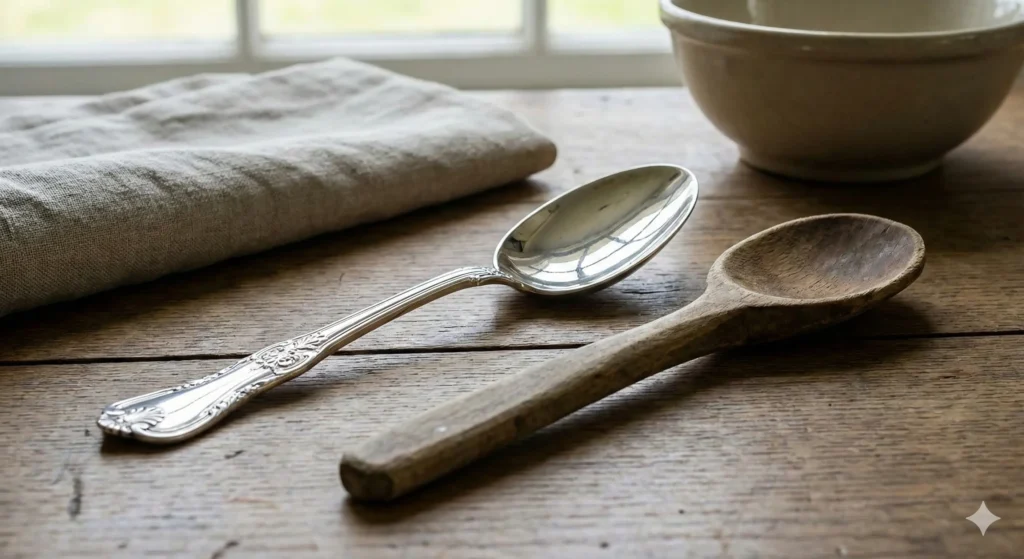
For the other 99% of the population—the peasants and farmers—there was only wood.
Travelers in the Middle Ages would carry their own personal wooden spoon tucked into their belt or hat. Inns and taverns did not provide cutlery; hygiene was suspect, and metal cutlery was too valuable to leave on tables. You were expected to bring your own. If you didn’t have your spoon, you didn’t eat.
4. The Original Dating App: The Welsh Lovespoon
Perhaps the most fascinating chapter in spoon history comes from 17th-century Wales. Before dating apps, text messages, or even written literacy, young men used woodworking to win a mate.
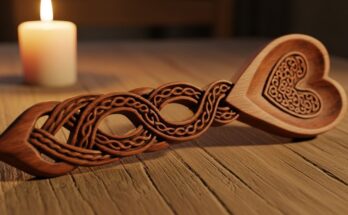
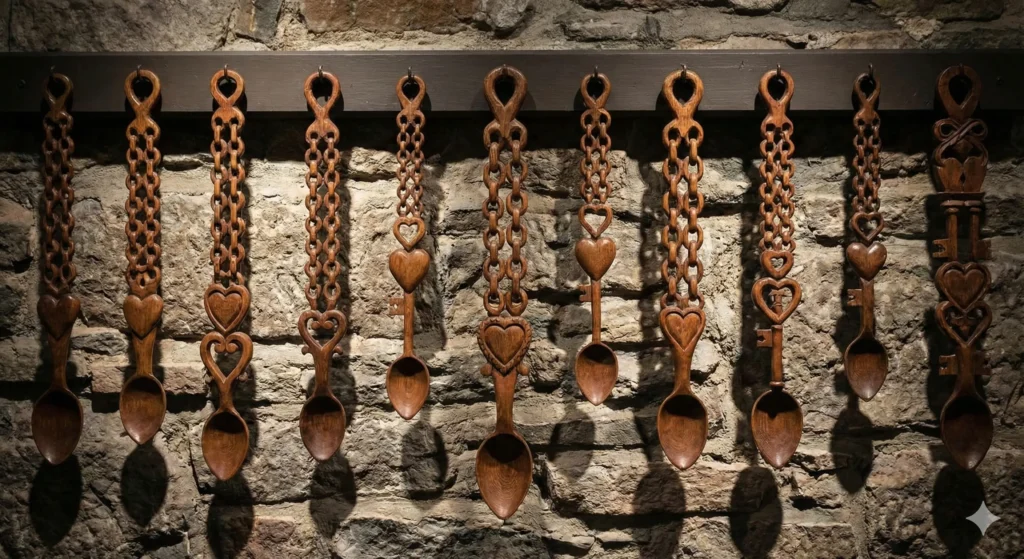
During the long, dark winter nights, young men would carve intricate Lovespoons (Llwyau Caru) from a single piece of wood. These were not functional spoons for eating porridge; they were elaborate, oversized masterpieces designed to show off the suitor’s skill.
A father would inspect the spoon to judge the young man. Was he patient? Was he skilled with his hands? Could he provide for a family?
Decoding the Symbols
The carved symbols were a secret language of love. Since many people couldn’t write, they “wrote” in wood:
- The Chain: Carved from a single piece of wood (no glue allowed), this symbolized the wish to be bound together forever.
- The Key: Symbolized “You hold the key to my heart” or “I will look after your home.”
- Beads in a Cage: The number of beads rattling inside a wooden cage often represented the number of children the man hoped to have.
- The Anchor: Symbolized settling down or safety.
- The Wheel: Symbolized that he would work hard for her.
If the girl accepted the spoon, they were officially “courting.” This custom is widely believed to be the origin of the English term “spooning,” meaning to lie close together, fitting like two spoons in a drawer.
5. Global Traditions: From Russia to Scandinavia
The Welsh weren’t the only ones obsessed with spoons.
Russia: The Musical Spoons (Lozhki)
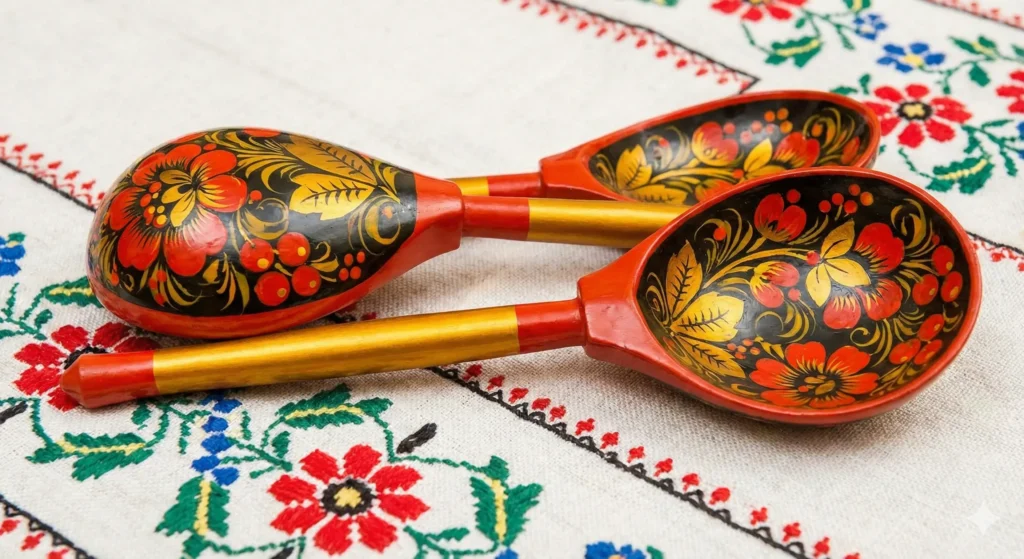
In Russia, the wooden spoon (lozhka) became a musical instrument. Made typically from birch or linden, these spoons are often painted in the famous Khokhloma style (black, red, and gold floral patterns). Russian folk musicians hold two or three spoons in one hand and click them together to create complex rhythmic beats. They are the “castanets” of the Slavic world.
Scandinavia: The Sloyd Tradition
In Sweden, the tradition is known as Sloyd (or Slöjd). It is a system of handicraft and education that emphasizes self-reliance. In the long, dark Nordic winters, farming was impossible. To survive, families would spend months indoors crafting wooden items—spoons, bowls, and kuksas (drinking cups)—to trade or use.
The “Mora knife,” a famous style of Swedish belt knife, became the standard tool for this work. Unlike the decorative Welsh spoons, Swedish spoons were utilitarian, minimal, and perfectly designed for eating.
6. Superstitions and Folklore
Because spoons were so essential to life, they attracted powerful superstitions:
- The Two-Spoon Omen: If you accidentally place two spoons in the same saucer or cup, it is said to mean a wedding is coming soon.
- Dropping a Spoon: In 19th-century folklore, dropping a spoon meant a child would soon visit your house. (Dropping a knife meant a man; a fork meant a woman).
- The Devil’s Spoon: There is an old proverb, “He who sups with the devil must use a long spoon.” This meant that if you deal with dangerous people, you should keep your distance.
7. The “Wooden Spoon” of Shame
The spoon hasn’t always been a symbol of romance or utility. Sometimes, it was an insult.
In sports like rugby (specifically the Six Nations Championship) or rowing, the “Wooden Spoon” is the booby prize given to the team that finishes last.
This tradition began at the University of Cambridge in the early 19th century. During the graduation ceremonies for the Mathematics degree, the student who achieved the lowest passing grade was mockingly lowered a giant wooden spoon from the balcony by his peers. It was a signal: “You are not made of gold or silver; you are merely wood.”

8. Why Wood Wins in the Modern Kitchen
Despite the invention of stainless steel, silicone, and plastic, every serious chef still keeps a jar of wooden spoons on the counter. Why has this primitive tool survived the Space Age?
Science gives us three reasons why wood is still king in the kitchen:
- Thermodynamics: Wood is an insulator. If you leave a metal spoon in a boiling pot of ragù, the handle becomes too hot to touch. A wooden spoon stays cool, allowing you to taste and stir without burning your hand.
- Gentleness: Modern non-stick pans and expensive enameled cast iron (like Le Creuset) are easily scratched by metal. Wood is firm enough to scrape up the delicious “fond” (browned bits) from the bottom of the pan but soft enough to never damage the cookware.
- Bacterial Safety: For years, people feared wood harbored bacteria. However, studies have shown that certain woods (like pine and oak) have natural antibacterial properties that suck moisture away from bacteria, causing them to die, whereas bacteria can survive longer on scratched plastic surfaces.
9. A Guide to Wood: What Are Spoons Made Of?
If you want to try carving (or buying) a quality wooden spoon, the type of wood matters immensely.
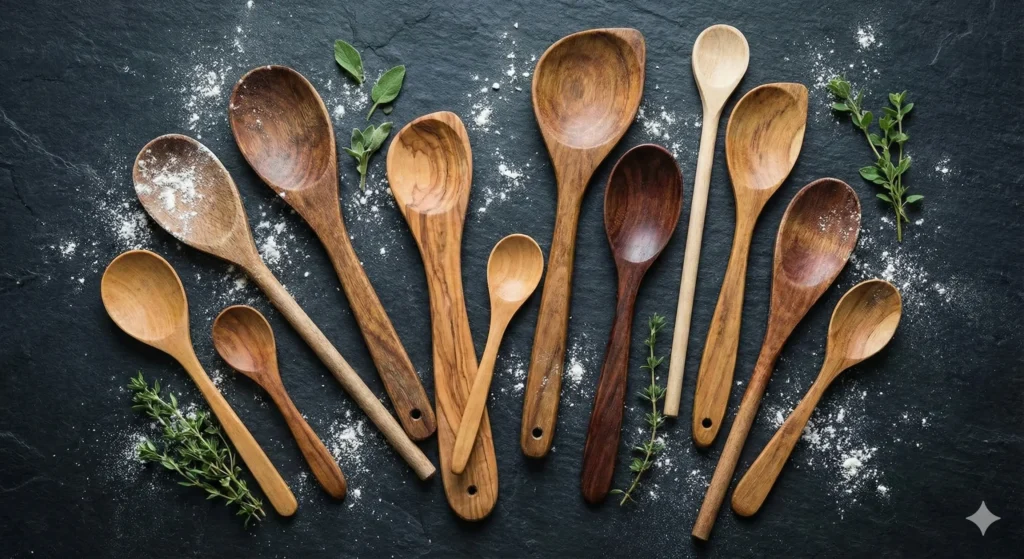
- Birch: The classic Nordic choice. It is pale, tough, and tasteless. It dries very hard and lasts for decades.
- Cherry: The romantic choice. It starts a light pinkish-brown but darkens to a deep, rich red-brown over years of use (oxidization). It is smooth and carves beautifully.
- Walnut: The luxury choice. Dark, chocolate-colored wood that looks stunning but can be slightly bitter if not sealed properly.
- Olive Wood: Popular in the Mediterranean. It has incredible, swirling grain patterns and is very hard, making it durable against water.
- Avoid: Oak (too porous/open grain) and Pine (tastes like resin/turpentine).
Conclusion: The Spoon Renaissance
We are currently living through a “Spoon Renaissance.” Hashtags like #spooncarving and #greenwoodworking have millions of views on social media.
In a world where we can buy a spoon for $1 at a supermarket, the act of spending three hours carving one by hand seems illogical. But that is exactly the point. Carving a spoon forces us to slow down. It requires us to understand the grain of the tree, the sharpness of the steel, and the movement of our own hands.
As the old woodworker’s saying goes:
“It takes three hours to carve a spoon, but it takes three generations to grow the wood.”
So, the next time you stir your coffee or eat your soup, take a moment to appreciate that simple “chip of wood.” It is a tool that has fed empires, courted lovers, made music, and survived centuries of change.